The Settings screen in Rresource Planner allows you to adjust the information that you wish to see in Resource Planner.
To display the Settings screen, click the "..." button on the right hand side of the Resource Planner's toolbar and then click Settings.
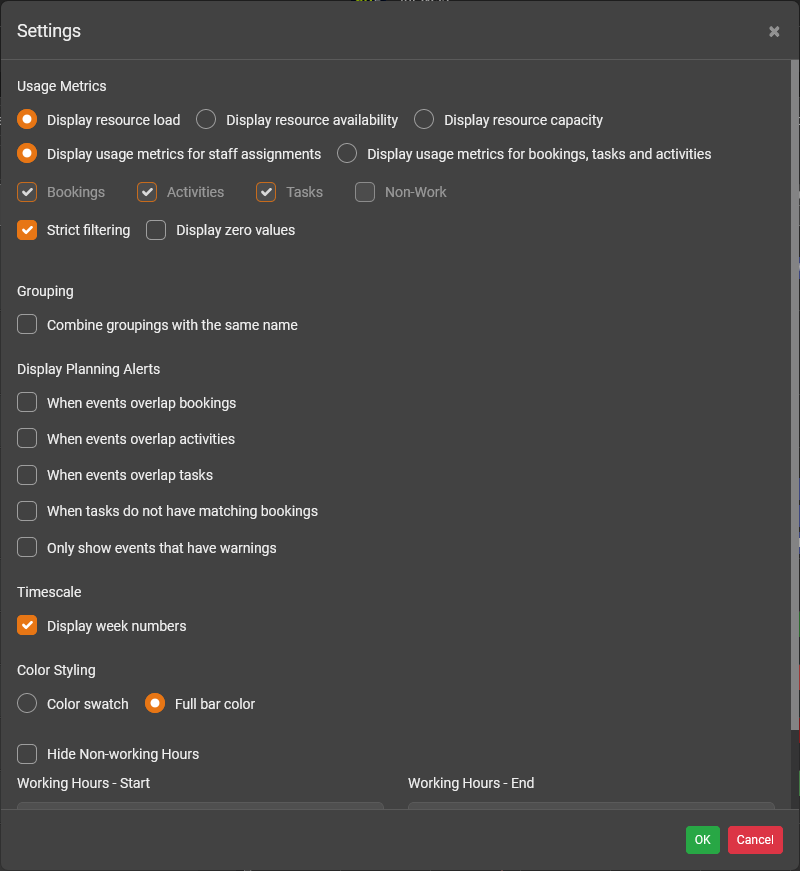
Usage Metrics
Click the Display resource load radio button to display usage metrics that tell you about amount of load placed on resources.
Example: You wish to see which resources the most load or are overallocated. In this case, you would turn on Display resource load radio button.
Click the Display resource availability radio button to display usage metrics about availability of resources.
Example: You wish to see which resources have good availability so you can allocate them to upcoming projects or tasks. In this case, you would turn the on Display resource availability radio button.Click the Display resource capacity radio button to display usage metrics about maximum capacity of resources.
Example: You wish to see how many resources you have week on week. In this case, you would turn on Display resource capacity radio button in Week timescale.Click the Display usage metrics for staff assignments radio button if you wish to see usage metrics for resources that have been assigned to staff.
Click the Display usage metrics for bookings, tasks and activities radio button if you wish to see usage metrics for resources that have been assigned to bookings, tasks and activities.
Click the Bookings checkbox to include bookings in the usage calculations and displayed usage metrics.
Example: You regard booking resources onto projects as an allocation and you want to measured as part of your resource usage metrics. In this case, you would turn on the Bookings checkbox. Click the Activities checkbox to include activities in the usage calculations and displayed usage metrics.
Example: You don't wish to count activities such as training as part of your resources' overall usage metrics. In this case, you would turn off the Activities checkbox.
Click the Tasks checkbox to include tasks in the usage calculations and displayed usage metrics.
Example: You want assigned tasks in projects to be counted in the overall resource usage metrics so you can see when your resources are overallocated. In this case, you would turn on the Tasks checkbox.Click the Non-Work checkbox to include non-work exceptions in the usage calculations and displayed usage metrics.
Example: You want any non-work for staff that have resources assigned to be counted in the overall resource usage metrics so you can see when your resources are being used. In this case, you would turn on the Non-Work checkbox.Click the Strict Filtering checkbox to restrict the usage metrics to only those bookings, activities and tasks that match the current filters.
Example: You wish to see how many resources are required from each department for a particular project. You would turn on department grouping and then filter by the project. Then you turn on Strict filtering. This restricts the usage metrics to just the project. Grouping
Click the Combine groupings with the same name checkbox is you wish to have just one group listed instead of many duplicate groups with the same name.
Example: You have 3 companies added into Projectal and each company has an Animation department. When grouping by Department, when this checkbox is clicked, there will only be one Animation department listed instead of three.Display Planning Alerts
Click the When events overlap bookings checkbox to display alert indicators on bookings when there are conflicting events.
Click the When events overlap activities checkbox to display alert indicators on bookings when there are conflicting events.
Click the When events overlap non-work checkbox to display alert indicators on bookings when there are conflicting events.
Click the When tasks do not have matching bookings checkbox to display alert indicators on tasks when they do not have a matching booking.
Click the Only show events that have warnings checkbox if you wish to hide all events that have no problems. This allows you to see just those events that have problems.
Display Week Numbers
Click the Display Week Numbers checkbox to display week numbers in the Planner. Week numbers are displayed when you have set the Timescale to Week mode.
Color Styling
Click the Color swatch radio button to display a small color swatch in events that represents the current selected color of the event.
Click the Full bar color radio button to fill the event's background with the current selected color of the event.
Hide Non-working Hours
Click the Hide Non-working Hours checkbox to hide the non-working hours in cells when in the Day timescale. This conveniently lets you see your events across the full width of a day's cell. Enter the starting and ending times for a typical work day.
Hide Weekends
Click the Hide Weekends checkbox to hide Saturday and Sunday when in the Day timescale. This conveniently lets you just see the typical Monday to Friday working days.
Tooltip Properties
Sets the information that wish to see displayed when you hover your mouse over activities, bookings and tasks in Resource Planner.
Select properties to display in tooltips from the dropdown lists.
Click and drag the selected properties to reorder them in the tooltip.
Was this article helpful?
That’s Great!
Thank you for your feedback
Sorry! We couldn't be helpful
Thank you for your feedback
Feedback sent
We appreciate your effort and will try to fix the article